
The Niagara Escarpment’s Ancient Arborvitae (White Cedar) Trees
Michael Schneider, July 23, 2025
The story of the community of plants that occupies the narrow strip of land along the edge of the Niagara Escarpment is, in essence, the story of one tree—Arborvitae (Thuja occidentalis), which is also called Cedar, White Cedar, Eastern White Cedar and Northern White Cedar. Arborvitae (pronounced “are burr vie ta”) is the dominant plant growing along the escarpment’s entire 650-mile-long arc. Other plants—certain trees, shrubs, vines, wildflowers and sedges—also grow there, but none of them dominate and define the Niagara Escarpment the way Arborvitae does.
Arborvitae is a conifer—a tree or shrub that produces cones. Although it’s also called various names that include the word Cedar, it’s not technically a Cedar. It’s even in a different plant family than the true Cedars. It’s in the Cypress Family, which also includes Redwood, Giant Sequoia, Baldcypress and all of the Junipers. True Cedars are native to the area surrounding the Mediterranean Sea, and are in the Pine Family, which includes Pines, Spruces, Firs, Douglas firs, Hemlocks and Larches.
Arborvitae means “tree of life.” (In Latin, arbor is tree, and vitae is life.) The origin of the name dates to French explorer, Jacques Cartier’s, 1535-1536 voyage to North America, when his crew was suffering from scurvy. Near to present-day Quebec, Iroquois people showed the crew how to boil Arborvitae foliage and bark to make tea. The tea contained enough vitamin C to cure scurvy. So Arborvitae was, literally, the tree of life for Cartier’s crew.
The edge of the Niagara Escarpment is a challenging environment for plants. The soil is thin in most places, with the bedrock often right at the surface. To survive, plant roots have to find cracks, crevices and other areas where soil has formed. Arborvitae are very good at finding this soil and using the water it holds. In addition, its scale-like needles are able to absorb water from rain, melting snow, dew and fog. Finally, the escarpment’s Arborvitae are genetically adapted to tolerate drought, a huge advantage in an area where there is so little soil.
Some of the Arborvitae growing along the edge—sometimes right out of the face of the cliff (This is called “the vertical forest.”)--are among the oldest trees in North America east of the Rocky Mountains. Only some of the Baldcypress in southern swamps are older, the oldest of them being about 2,600 years old. The oldest documented Arborvitae along the Niagara Escarpment are nearly 1,900 years old. Living for so long in such a challenging environment is a testimony to their drought tolerance. But they are only able to grow very slowly, some so slowly that a microscope is needed to count the annual growth rings.
The Arborvitae along the Niagara Escarpment edge have never been commercially harvested for lumber. This is in part because of the challenging terrain and access, but mostly because the trees are either too small or too misshapen to be of commercial use. So location, size and growth habit spared this ancient forest. However, many of them have been cut to open a view to the water from houses built near the edge.
Other native trees, shrubs and vines that can be found growing among the Niagara Escarpment’s Arborvitae include White Pine, Red Pine, Paper Birch, Quaking Aspen, Ironwood, Balsam Fir, Allegheny Serviceberry, Common Chokecherry, Beaked Hazelnut, Roundleaf Dogwood, Russet Buffaloberry, Dwarf Bush honeysuckle, River Grape and Virginia Creeper.. Native herbaceous plants include Bigleaf Aster, Zigzag Goldenrod, Large White Trillium, Canada Mayflower, Lyreleaf Rockcress, Starry False Solomon’s Seal and Ivory Sedge.
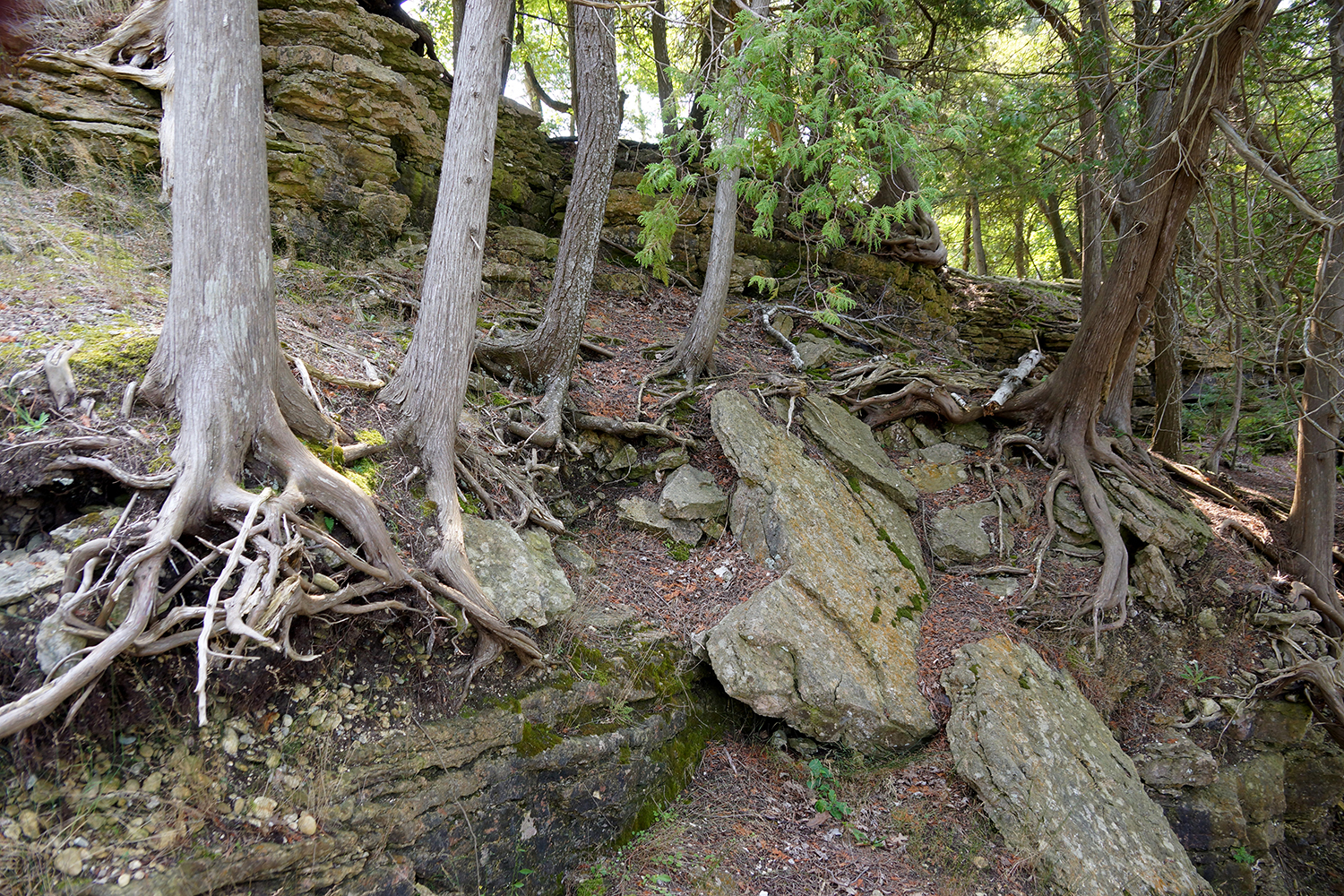
Arbor vitae trees cling to the edge of the Niagara Escarpment in Door County. Photo courtesy of Suzi Hass.